阴阳谜题:用整数编号来表达同色格的连通性#
本章的内容#
阴阳是把盘面涂成黑白的谜题,由于没有 add_circuit() 那样的现成约束,模型只能自己搭建。
每格带两个变量,即颜色与遍历顺序
相邻的同色格之间,必定按其中一个方向的边相连
编号递增的方向连边,同色格因而全部连通
不造出同色的 2×2 方块,即不让四格同色
四条里,前三条合起来实现连通,最后一条禁止同色的方块。
规则#
在长方形的网格中,有些格一开始就放着黑或白的棋子,其余格涂色,使下面三条成立。
所有黑格通过上下左右的连接成为一个整体
所有白格通过上下左右的连接成为一个整体
不能出现同色的 2×2 方块
规则的三条里,前两条说的是连通,第三条说的是形状。
中心带点的格就是题目给出的棋子。
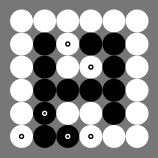
阴阳谜题的网站
https://www.puzzle-yin-yang.com/
用 helper.puzzle.extract_yinyan() 可以取得这个网站上的谜题盘面。打开浏览器的开发者工具,把表示盘面的 <div> 标签的代码复制下来,交给这个函数执行,盘面就会以数组的形式取得。
盘面#
1 是白棋子,2 是黑棋子,0 是空格。
import numpy as np

puzzle = np.loadtxt('data/yinyang01.txt', dtype=np.uint8)
print(puzzle)
[[0 0 0 0 0 0]
 [0 0 1 0 0 0]
 [0 0 0 1 0 0]
 [0 0 0 0 0 0]
 [0 2 0 0 0 0]
 [1 0 2 1 0 0]]
from ortools.sat.python import cp_model
import numpy as np
from collections import defaultdict
思路#
每格带下面两个变量。
变量 |
含义 |
|---|---|
|
假为白,真为黑 |
|
在同色之中第几个被遍历 |
颜色决定哪些格要连通,编号决定用哪一组边把它们连起来。
在相邻格之间还要准备有向边,其中 edge12 表示格 1 到格 2,edge21 表示反方向。约束共有七条。
两个方向不能同时选,即
edge12与edge21不能同时为真有边则同色,即
edge12为真则color1 == color2同色则必有边,即
color1 == color2时edge12与edge21中必有一个为真方向与编号,即
edge12为真则step1 < step2每格的入口只有一个,除起点之外,进入的边恰好一条
起点没有入口,白与黑的起点,进入的边都是 0 条
禁止 2×2,即四格不能同色
把第 2 条与第 3 条合起来,同色的格之间必定有边;再由第 4 条与第 5 条,从起点沿编号递增的方向走,可以到达每一格,也就是同色格成为一个整体,这正是连通的含义。编号在这里不是装饰,而是把连通换成了沿边递增可达。
起点在白与黑中各选一个即可,这相当于每种颜色各造一棵树。
def solve_yinyang(puzzle):
    """求解 Yin-Yang,返回(颜色、编号、选中的边)"""
    model = cp_model.CpModel()
    h, w = puzzle.shape
    edges = []

    colors = {}
    steps = {}

    for (r, c), v in np.ndenumerate(puzzle):
        colors[r, c] = model.new_bool_var(f'color_{r}_{c}')
        steps[r, c] = model.new_int_var(0, h * w, f'step_{r}_{c}')
        if c + 1 < w:
            edges.extend([(r, c, r, c + 1), (r, c + 1, r, c)])
        if r + 1 < h:
            edges.extend([(r, c, r + 1, c), (r + 1, c, r, c)])

    edge_variables = {e: model.new_bool_var(f'edge_{e}') for e in edges}

    out_edges = defaultdict(list)
    in_edges = defaultdict(list)
    for e in edges:
        out_edges[e[:2]].append(e)
        in_edges[e[2:]].append(e)

    # 起点(白、黑各自第一颗棋子)
    whites = np.where(puzzle == 1)
    blacks = np.where(puzzle == 2)
    start_locs = [(whites[0][0], whites[1][0]), (blacks[0][0], blacks[1][0])]

    for (r1, c1, r2, c2) in edges:
        n1, n2 = (r1, c1), (r2, c2)
        if n1 > n2:
            continue        # 每对只处理一次

        cell1, cell2 = colors[n1], colors[n2]
        step1, step2 = steps[n1], steps[n2]
        edge12, edge21 = edge_variables[r1, c1, r2, c2], edge_variables[r2, c2, r1, c1]

        # 1. 不同时选两个方向
        model.add_bool_or(~edge12, ~edge21)
        # 2. 有边就同色(4 种组合用 CNF 写)
        model.add_bool_or(~cell1, cell2, ~edge12)
        model.add_bool_or(cell1, ~cell2, ~edge12)
        model.add_bool_or(~cell1, cell2, ~edge21)
        model.add_bool_or(cell1, ~cell2, ~edge21)
        # 3. 同色时,必有一个方向的边
        model.add_bool_or(cell1, cell2, edge12, edge21)
        model.add_bool_or(~cell1, ~cell2, edge12, edge21)
        # 4. 沿边的方向编号递增
        model.add(step1 < step2).only_enforce_if(edge12)
        model.add(step1 > step2).only_enforce_if(edge21)

    for (r, c), v in np.ndenumerate(puzzle):
        in_vars = [edge_variables[e] for e in in_edges[r, c]]
        out_vars = [edge_variables[e] for e in out_edges[r, c]]

        if (r, c) not in start_locs:
            # 5. 起点以外,入边恰好 1 条
            model.add(sum(in_vars) == 1)
            model.add(steps[r, c] > 0)
        else:
            # 6. 起点没有入边,出边 1 条以上
            model.add(sum(in_vars) == 0)
            model.add(sum(out_vars) > 0)
            model.add(steps[r, c] == 0)

        # 固定棋子的颜色
        if v == 1:
            model.add_bool_and(~colors[r, c])
        elif v == 2:
            model.add_bool_and(colors[r, c])

    # 7. 不允许同色的 2×2
    for r in range(h - 1):
        for c in range(w - 1):
            quad = [colors[r, c], colors[r + 1, c], colors[r, c + 1], colors[r + 1, c + 1]]
            model.add_bool_or(quad)                        # 全白不行
            model.add_bool_or([~v for v in quad])          # 全黑也不行

    solver = cp_model.CpSolver()
    solver.parameters.max_time_in_seconds = 120
    status = solver.solve(model)
    print("status:", solver.status_name(status))

    cells = {key: solver.value(val) for key, val in colors.items()}
    numbers = {key: solver.value(val) for key, val in steps.items()}
    chosen = [key for key, val in edge_variables.items() if solver.value(val)]
    return cells, numbers, chosen
补充:为什么写成 CNF#
也可以写成 model.add(cell1 == cell2).only_enforce_if(edge12),但把比较式作为条件的形式,CP-SAT 有时难以求解,因此这里展开成“…或…”的形式,即 CNF。展开之后子句变多,但每条都只含布尔变量,求解器处理起来更直接。
~edge12 | ~edge21:两个不能同时成立~cell1 | cell2 | ~edge12:edge12为真则cell1 → cell2cell1 | ~cell2 | ~edge12:edge12为真则cell2 → cell1
由后两条子句就得到“edge12 为真则 cell1 == cell2”。edge21 方向同理再写两条,四条蕴含子句合起来,边的方向与同色的关系就完整了。
绘制#
涂上颜色,再把编号与边叠加上去显示。
from matplotlib import pyplot as plt
from matplotlib.collections import LineCollection


def plot_yinyang(puzzle, cells=None, numbers=None, edges=None, scale=0.3):
    h, w = puzzle.shape
    fig, ax = plt.subplots(figsize=(w * scale, h * scale))

    if cells is not None:
        xs, ys, colors = [], [], []
        for (y, x), v in cells.items():
            xs.append(x)
            ys.append(y)
            colors.append('white' if v == 0 else 'black')
        ax.scatter(xs, ys, s=80 * scale / 0.1, c=colors)

    if numbers:
        for (r, c), num in numbers.items():
            color = 'black' if cells[r, c] == 0 else 'white'
            ax.text(c, r, str(num), color=color, size=9)

    if edges:
        segments = []
        for r1, c1, r2, c2 in edges:
            segments.append([(c1, r1), (c2, r2)])
        ax.add_collection(LineCollection(segments, alpha=0.7))

    y, x = np.where(puzzle == 1)
    ax.scatter(x, y, s=8, edgecolor="#000000", facecolor="none")

    y, x = np.where(puzzle == 2)
    ax.scatter(x, y, s=8, edgecolor="#ffffff", facecolor="none")

    ax.set_aspect('equal')
    fig.patch.set_facecolor('#777777')
    ax.set_xlim(-0.5, w - 0.5)
    ax.set_ylim(-0.5, h - 0.5)
    ax.invert_yaxis()
    ax.axis('off')
    return fig, ax
解出题目#
下面解出题网站上的实际题目,先解一道小盘面,再试大盘面。
%%time
puzzle = np.loadtxt('data/yinyang02.txt', dtype=np.uint8)
cells, numbers, edges = solve_yinyang(puzzle)
plot_yinyang(puzzle, cells=cells);
status: OPTIMAL
CPU times: total: 3.11 s
Wall time: 341 ms
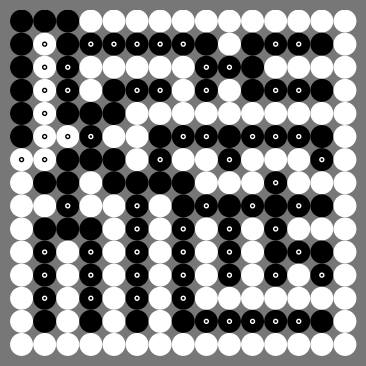
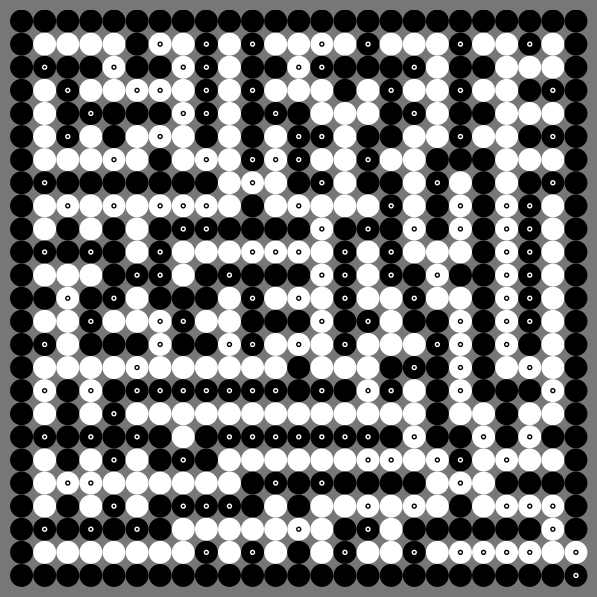
更大的 25×25 盘面则要花相当长的时间。规模变大之后,编号与边的组合随之增加,求解时间增长很快。
%%time
puzzle = np.loadtxt('data/yinyang03.txt', dtype=np.uint8)
cells, numbers, edges = solve_yinyang(puzzle)
plot_yinyang(puzzle, cells=cells);
status: OPTIMAL
CPU times: total: 4min 28s
Wall time: 14.8 s
验算#
确认两种颜色是否各自连通,并确认是否出现了 2×2 方块,验算只检查结果,与建模方式无关。
def check_yinyang(puzzle, cells):
    h, w = puzzle.shape
    grid = np.array([[cells[r, c] for c in range(w)] for r in range(h)])

    # 3. 没有同色的 2×2
    for r in range(h - 1):
        for c in range(w - 1):
            quad = grid[r:r+2, c:c+2]
            if quad.min() == quad.max():
                return False, f"有同色的 2×2 {(r, c)}"

    # 1, 2. 每种颜色都连通
    for color, name in ((0, "白"), (1, "黑")):
        points = {(r, c) for r in range(h) for c in range(w) if grid[r, c] == color}
        if not points:
            continue
        start = next(iter(points))
        seen = {start}
        stack = [start]
        while stack:
            r, c = stack.pop()
            for dr, dc in ((1, 0), (-1, 0), (0, 1), (0, -1)):
                nb = (r + dr, c + dc)
                if nb in points and nb not in seen:
                    seen.add(nb)
                    stack.append(nb)
        if seen != points:
            return False, f"{name}色分成了两块以上"

    return True, "两种颜色都连通,也没有 2×2"


print(check_yinyang(puzzle, cells))
(True, '两种颜色都连通,也没有 2×2')
小结#
用颜色与遍历顺序两个变量,就可以表示同色的连通
相邻的同色格之间必定按其中一个方向的边相连,编号沿边的方向递增
把每格的入口限制为一条,从起点出发就能走到每一格,也就是连通
禁止 2×2 可以用四格的 OR 与它的否定的 OR 写出
比较式不适合作为条件,因此展开成 CNF,用
add_bool_or给出25×25 这样大的盘面需要相当的时间,也可以指定时间上限
出题网站上也有一些盘面只给了一种颜色的棋子,由于起点是按颜色分别选取的,这种情况下就要另行设计另一种颜色的起点,例如把它固定在某个已知的格上。