解数织:用位置变量把 CNF 变小#
本章的内容#
本章用 SAT 解数织,重点在于如何把 CNF 造得更小。
由一行的提示,列出全部可能的涂法,这是一个递归的过程
把候选原样写成 CNF,组合会爆炸,速度随之变慢
把每个数字的起始位置做成变量,CNF 会小得多,求解也快得多
最后还要解一道 45×60 的大型题目。三节的顺序也就是优化的顺序:先看候选从哪里来,再看它在 CNF 里有多大,最后换成另一种变量。
数织的规则#
数织是以数字为线索涂格的谜题。
盘面是正方形的网格,每一格涂黑或留白
行左边的数字,是该行连续黑格的长度按顺序排成的
列上方或下方的数字也是同样
所有黑格确定之后,题目就完成了
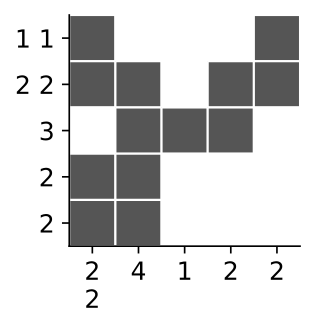
把每一格用“涂黑则为真”的布尔变量表示,再把行与列的提示写成约束。行与列的提示看似两套约束,却落在同一批格变量上,因此两个方向的条件会互相牵制。
from matplotlib import pyplot as plt
import numpy as np
import itertools
列出一行的全部解#
paint_numbers(numbers, count) 造出把 numbers 的数字排进长度为 count 的一行中的所有涂法,涂的格记作 1,不涂的格记作 -1。
这可以用递归写出,终止条件有两个。
排下这些数字所需的格数超过
count,此时无解,例如[2, 1, 5]至少需要 2+1+5+2 = 10 格只剩最后一个数字,此时把该长度的方块放在所有可以放置的位置上
若不属于上述两种,就分两个方向分支。
把第一个数字放在这里,其余部分递归求解,即涂
numbers[0]格,再空出一格这一格留白,其余部分递归求解
前两个分支是终止条件,后两个各消耗一格或一个数字,因此递归一定会停下。
def paint_numbers(numbers, count):
    """返回把 numbers 的数字排在宽度 count 里的所有涂法(1=黑, -1=白)"""
    if sum(numbers) + len(numbers) - 1 > count:
        return                      # 1. 格子不够

    if len(numbers) == 1:
        n = numbers[0]
        for i in range(count - n + 1):          # 2. 最后一个数字放在所有能放的位置
            yield [-1] * i + [1] * n + [-1] * (count - i - n)
        return

    # 3. 把开头的数字放在当前位置(后面空 1 个格子)
    for rest in paint_numbers(numbers[1:], count - numbers[0] - 1):
        yield [1] * numbers[0] + [-1] + rest

    # 4. 空出这个格子,向右挪一格
    for rest in paint_numbers(numbers, count - 1):
        yield [-1] + rest
下面是把 [2, 1, 5] 排进 12 格的例子,为便于阅读,把 -1 显示成 0。每一行都是一整行的涂法,不是一次涂一格。
for line in paint_numbers([2, 1, 5], 12):
    print([int(x > 0) for x in line])
[1, 1, 0, 1, 0, 1, 1, 1, 1, 1, 0, 0]
[1, 1, 0, 1, 0, 0, 1, 1, 1, 1, 1, 0]
[1, 1, 0, 1, 0, 0, 0, 1, 1, 1, 1, 1]
[1, 1, 0, 0, 1, 0, 1, 1, 1, 1, 1, 0]
[1, 1, 0, 0, 1, 0, 0, 1, 1, 1, 1, 1]
[1, 1, 0, 0, 0, 1, 0, 1, 1, 1, 1, 1]
[0, 1, 1, 0, 1, 0, 1, 1, 1, 1, 1, 0]
[0, 1, 1, 0, 1, 0, 0, 1, 1, 1, 1, 1]
[0, 1, 1, 0, 0, 1, 0, 1, 1, 1, 1, 1]
[0, 0, 1, 1, 0, 1, 0, 1, 1, 1, 1, 1]
共有 9 种涂法。人逐行观察就能看出“这一格必定是黑的”,而 SAT 求解器必须把全部候选都告诉它。候选越多,写进 CNF 的内容就越多,这是后面所有优化的动机。
从 DNF 变到 CNF#
paint_numbers() 返回的每一种涂法,都是这一格涂黑、那一格留白这样的 AND 条件,而这些项再用 OR 连起来,因此它是 DNF,即析取范式。SAT 求解器只能解 CNF,即合取范式,因此需要转换。
用分配律把 DNF 直接变成 CNF,式子会爆炸,因此引入新的变量。例如 A、B、C 之中恰好一个为假这个 DNF
给每一项各分配一个新变量 X、Y、Z,再用等价关系 \(\Leftrightarrow\) 连接。
\(P \Leftrightarrow Q\) 可以写成 CNF
把它套到 \(X \Leftrightarrow (\neg A \wedge B \wedge C)\) 上,就得到下面四个子句。
下面用 SymPy 确认。
from sympy import symbols, Equivalent
from sympy.logic.boolalg import to_cnf

X, A, B, C = symbols("X A B C")
to_cnf(Equivalent(X, ~A & B & C))
结果与上式同形,只是子句的顺序不同,这种转换称为 Tseitin 变换,好处是能把式子的长度控制住。代价是引入新变量,解的规模变大,但子句数目不再随候选个数膨胀。
dnf_to_cnf(dnf) 给 DNF 的每一项分配一个新变量,并造出上面那四个子句。
对每一项造一个新变量
zz → 各个文字,即造出[-z, v],其中 v 是项中含有的变量项 → z,即造出[z] + [-v for v in term]最后造一个把所有
z用 OR 连起来的子句
新变量的编号必须大于已有变量的最大编号,把 new_vars 传进去,它就会用该编号之后的部分。
def dnf_to_cnf(dnf, new_vars=None):
    """用 Tseitin 变换把 DNF 变成 CNF"""
    if new_vars is None:
        # 使用现有变量最大编号之后的编号
        start = max(max(map(abs, term)) for term in dnf) + 1
        new_vars = iter(range(start, start + len(dnf)))

    zlist = []      # 新变量的列表
    cnf = []
    for term in dnf:
        z = next(new_vars)
        zlist.append(z)
        cnf.append([z] + [-v for v in term])   # 是项则为 z(项 → z)
        for v in term:
            cnf.append([-z, v])                # z 则为各文字(z → 文字)
    cnf.append(zlist)                          # z 中至少一个为真
    return cnf
下面用三个变量中恰好一个为假的 DNF 做一次转换,得到的解中应当恰好有一个变量为假;enum_models() 返回满足条件的全部解,可以直接对照。
from pprint import pprint
from pysat.solvers import Solver

dnf = [[-1, 2, 3], [1, -2, 3], [1, 2, -3]]
cnf = dnf_to_cnf(dnf)

print("CNF")
pprint(cnf)

print("solutions")
sat = Solver()
sat.append_formula(cnf)
for sol in sat.enum_models():
    print([int(x > 0) for x in sol])
CNF
[[4, 1, -2, -3],
 [-4, -1],
 [-4, 2],
 [-4, 3],
 [5, -1, 2, -3],
 [-5, 1],
 [-5, -2],
 [-5, 3],
 [6, -1, -2, 3],
 [-6, 1],
 [-6, 2],
 [-6, -3],
 [4, 5, 6]]
solutions
[0, 1, 1, 1, 0, 0]
[1, 0, 1, 0, 1, 0]
[1, 1, 0, 0, 0, 1]
增加了新变量 4、5、6,而原有的三个变量中,每个解都只有一个为假。新变量只是中介,原变量之间的关系并没有改变,两者解出的解集仍然相同。
也可以核对 paint_numbers() 的结果,DNF 的解与转成 CNF 之后解出的结果应当是同一个集合。
n = 12
solutions = list(paint_numbers([2, 1, 5], n))
variables = list(range(1, n + 1))

# 把涂法变成 DNF(变量编号 × 1 或 -1)
dnf = [[v * t for v, t in zip(variables, term)] for term in solutions]

sat = Solver()
sat.append_formula(dnf_to_cnf(dnf))
# 只取出 n 个变量,把符号统一成 -1/1
solutions_cnf = [[x // abs(x) for x in res[:n]] for res in sat.enum_models()]

print(sorted(solutions) == sorted(solutions_cnf))
True
解数织的朴素做法#
由行与列的提示直接造出 CNF。
给每一格分配一个布尔变量,编号 1 到宽乘高
为转换所需的新变量准备编号
对每一行与每一列分别用
paint_numbers()造出 DNF,转成 CNF 之后加入用
Solver求解,再还原成(高度, 宽度)的形状用
plot()画出来
每一行都走完整条流程,行的候选越多,这一行产生的子句就越多。
class NonogramSimpleSolver:
    """把提示直接变成 CNF 的朴素求解器"""

    def __init__(self, rows, cols, width=None, height=None):
        if width is None:
            width = len(cols)
        if height is None:
            height = len(rows)
        self.rows = rows
        self.cols = cols
        self.width = width
        self.height = height
        self.var_count = width * height

        # 各格子的变量(按行排的二维数组)
        self.vars = np.arange(1, self.var_count + 1).reshape(-1, width)
        # 转换用的新变量编号(从格子变量的下一个编号开始)
        self.new_vars = itertools.count(self.var_count + 1)

        self.cnf = []
        for i, row in enumerate(rows):
            self.add_constraints(row, width, self.vars[i, :].tolist())
        for j, col in enumerate(cols):
            self.add_constraints(col, height, self.vars[:, j].tolist())

    def add_constraints(self, numbers, count, variables):
        """把 1 行(或 1 列)的提示转换成 CNF 并追加"""
        dnf = []
        for pattern in paint_numbers(numbers, count):
            dnf.append([v * p for v, p in zip(variables, pattern)])
        self.cnf.extend(dnf_to_cnf(dnf, new_vars=self.new_vars))

    def solve(self):
        sat = Solver()
        sat.append_formula(self.cnf)
        if not sat.solve():
            raise ValueError("没有找到解")
        model = sat.get_model()
        solution = np.sign(np.array(model[:self.var_count])).reshape(self.height, self.width)
        self.solution = (solution + 1) // 2      # 把 -1/1 换成 0/1
        return self.solution

    def plot(self, font_size=9):
        from helper.plot import plot_nonogram_board
        return plot_nonogram_board({"rows": self.rows, "cols": self.cols},
                                   self.solution, font_size=font_size)
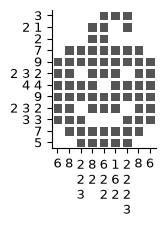
下面解一道小题目。
rows = [
    [3],
    [2, 1],
    [2],
    [7],
    [9],
    [2, 3, 2],
    [4, 4],
    [9],
    [2, 3, 2],
    [3, 3],
    [7],
    [5]
]

cols = [
    [6],
    [8],
    [2, 2, 3],
    [8, 2],
    [6, 2, 2],
    [1, 6, 2],
    [2, 2, 2, 3],
    [8],
    [6]
]

pbn = NonogramSimpleSolver(rows, cols)
pbn.solve()
pbn.plot();
从文件读入再求解#
solve_and_paint(fn, solver) 用 solver 解开 JSON 文件中的题目并画出来。求解器作为参数传入,换实现时调用处不用改。
数织谜题的网站
https://www.nonograms.org/nonograms
用 helper.puzzle.extract_nonogram() 可以取得这个网站上的数织盘面。打开浏览器的开发者工具,把表示盘面的 <table> 标签复制下来,交给这个函数执行,就会返回表示盘面的字典。
import json


def solve_and_paint(fn, solver, font_size=9):
    if isinstance(fn, dict):
        data = fn
    else:
        with open(fn) as f:
            data = json.load(f)

    pbn = solver(data["rows"], data["cols"])
    pbn.solve()
    pbn.plot(font_size=font_size)
下面解 nonogram02.json,并计时。
%time solve_and_paint("data/nonogram02.json", solver=NonogramSimpleSolver)
CPU times: total: 8.67 s
Wall time: 8.97 s
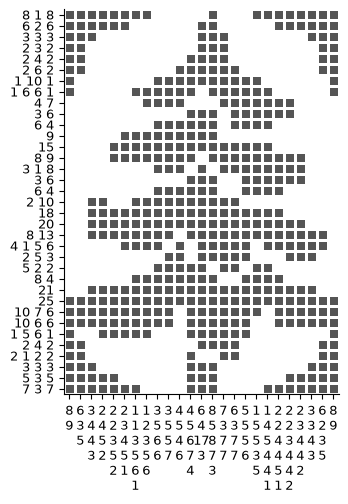
花了十秒以上,原因是格数一多,每一行的涂法候选就迅速增加,CNF 的子句数也随之爆炸。这正是下一节要换变量的理由。
用位置变量提速#
DNF 到 CNF 的转换会按候选的个数造出新变量与子句,例如数字为 [1, 2, 3, 2, 1]、宽度为 30 时,涂法多达 26,334 种,而这个数目还只是单行,整张盘面要把每一行与每一列的候选都算进去。
len(list(paint_numbers([1, 2, 3, 2, 1], 30)))
26334
为了避免这种组合爆炸,改为把每个数字的起始位置做成变量。
要在宽度 10 里放 [1, 2, 3],数字 1 的起始位置只有 0、1、2 三种。不去数涂法的候选,而数每个数字从哪里开始,这正是这一步的关键。
create_position_variables(numbers, count, new_bool_variables) 对每个数字造出 {起始位置: 变量编号} 的字典。
start_pos():把数字紧挨着排下时,各数字的起始位置end_pos():右端对齐时,各数字的起始位置,也就是可以放置的最大起始位置
例如把 [1, 2, 3] 放进宽度 10 时,数字 3 的起始位置是 5〜7。候选从“整行有几种涂法”变成“每个数字有几个起点”,数目由乘积级降到和级。
def start_pos(numbers, count):
    """靠左排列时各数字的起始位置"""
    s = 0
    for n in numbers:
        yield s
        s += n + 1


def end_pos(numbers, count):
    """靠右对齐时各数字的起始位置(= 能放的最大起始位置)"""
    width = sum(numbers) + len(numbers) - 1
    start = count - width
    for pos in start_pos(numbers, count):
        yield start + pos


def create_position_variables(numbers, count, new_bool_variables):
    """生成 {起始位置: 变量编号} 的列表"""
    pos_variables = []
    for a, b in zip(start_pos(numbers, count), end_pos(numbers, count)):
        pos_variables.append({j: next(new_bool_variables) for j in range(a, b + 1)})
    return pos_variables


numbers = [1, 2, 3]
count = 10
pos_variables = create_position_variables(numbers, count, itertools.count(1))
pos_variables
[{0: 1, 1: 2, 2: 3}, {2: 4, 3: 5, 4: 6}, {5: 7, 6: 8, 7: 9}]
数字 1 的起始位置是 0〜2,数字 2 是 2〜4,数字 3 是 5〜7,这些都可以与 paint_numbers() 的候选对照。位置变量的个数就是把每个数字可放置的起点数相加。
for line in paint_numbers([1, 2, 3], 10):
    print([int(x > 0) for x in line])
[1, 0, 1, 1, 0, 1, 1, 1, 0, 0]
[1, 0, 1, 1, 0, 0, 1, 1, 1, 0]
[1, 0, 1, 1, 0, 0, 0, 1, 1, 1]
[1, 0, 0, 1, 1, 0, 1, 1, 1, 0]
[1, 0, 0, 1, 1, 0, 0, 1, 1, 1]
[1, 0, 0, 0, 1, 1, 0, 1, 1, 1]
[0, 1, 0, 1, 1, 0, 1, 1, 1, 0]
[0, 1, 0, 1, 1, 0, 0, 1, 1, 1]
[0, 1, 0, 0, 1, 1, 0, 1, 1, 1]
[0, 0, 1, 0, 1, 1, 0, 1, 1, 1]
位置变量的约束#
位置变量需要两类约束。
每个数字的起始位置在候选中恰好一个
设数字
i的起始位置为p1、下一个数字的起始位置为p2,则要求p2 >= p1 + num[i] + 1,即至少空出一格
第 2 条可以写成 [-p1_var, -p2_var] 这样的子句,即 p1 与 p2 之间间隔不足的组合不能同时为真。这一条只在相邻的两个数字之间成立,因此子句的数目与数字个数成正比。
only_one_true() 负责恰好一个,pairwise() 是把相邻元素两两配对的辅助函数。
def only_one_true(variables):
    """变量中恰好一个为 True 的 CNF"""
    yield list(variables)                     # 至少一个
    for i, j in itertools.combinations(variables, 2):
        yield [-i, -j]                        # 两个同时不行


def pairwise(iterable):
    """生成 (a0,a1), (a1,a2), ..."""
    a, b = itertools.tee(iterable)
    next(b, None)
    return zip(a, b)


def position_variables_constraint(pos_variables, numbers):
    cnf = []

    # 1. 每个数字的起始位置只有一个
    for pos_var in pos_variables:
        cnf.extend(only_one_true(pos_var.values()))

    # 2. 相邻数字要分开,不能重叠
    for i, (pos_var1, pos_var2) in enumerate(pairwise(pos_variables)):
        gap = numbers[i] + 1
        for pos1, pos2 in itertools.product(pos_var1, pos_var2):
            if pos2 < pos1 + gap:
                cnf.append([-pos_var1[pos1], -pos_var2[pos2]])
    return cnf


cnf = position_variables_constraint(pos_variables, numbers)
cnf
[[1, 2, 3],
 [-1, -2],
 [-1, -3],
 [-2, -3],
 [4, 5, 6],
 [-4, -5],
 [-4, -6],
 [-5, -6],
 [7, 8, 9],
 [-7, -8],
 [-7, -9],
 [-8, -9],
 [-2, -4],
 [-3, -4],
 [-3, -5],
 [-5, -7],
 [-6, -7],
 [-6, -8]]
下面把 cnf 解出来,再还原成格的涂法。
起始位置的变量为真,就从该位置起把该数字涂
num[i]格cell_map是变量编号到起始位置与数字的对应表
sat = Solver()
sat.append_formula(cnf)

cell_map = {}
for n, pos_var in zip(numbers, pos_variables):
    for pos, var in pos_var.items():
        cell_map[var] = (pos, n)

for sol in sat.enum_models():
    cells = [0] * count
    for var, v in enumerate(sol, 1):
        if v > 0:
            pos, n = cell_map[var]
            for j in range(pos, pos + n):
                cells[j] = 1
    print(cells)
[1, 0, 1, 1, 0, 1, 1, 1, 0, 0]
[1, 0, 1, 1, 0, 0, 1, 1, 1, 0]
[1, 0, 1, 1, 0, 0, 0, 1, 1, 1]
[1, 0, 0, 0, 1, 1, 0, 1, 1, 1]
[0, 0, 1, 0, 1, 1, 0, 1, 1, 1]
[0, 1, 0, 0, 1, 1, 0, 1, 1, 1]
[0, 1, 0, 1, 1, 0, 1, 1, 1, 0]
[1, 0, 0, 1, 1, 0, 1, 1, 1, 0]
[1, 0, 0, 1, 1, 0, 0, 1, 1, 1]
[0, 1, 0, 1, 1, 0, 0, 1, 1, 1]
得到了同样的 10 种涂法,与 paint_numbers() 相比,变量与子句都少得多。
把格变量与位置变量连起来#
到此为止只是决定了一行之内的位置,而数织中行与列共用同一批格,因此要追加约束,把格变量与位置变量连接起来。
格 j 与位置的关系有下面四种。四种情形把整行切成几段,判断一段属于哪一种只需要比较下标。
第一个方块之前的格是白的,即
pos[0]之前cell = 0最后一个方块之后的格是白的,即
pos[-1] + num[-1]之后cell = 0方块之内是黑的,即
pos[i] <= j < pos[i] + num[i]时cell = 1方块之间是白的,即
pos[i] + num[i] <= j < pos[i+1]时cell = 0
这些都可以用“位置变量为真,则格变量如此”的蕴含写出,例如 -pos_var, cell_var。四种情形各对应一段格,合起来正好覆盖整行。
def cell_variables_constraint(pos_variables, cell_variables, numbers, count):
    cnf = []

    # 3. 块之中是黑
    for i, pos_var in enumerate(pos_variables):
        for pos, var in pos_var.items():
            for j in range(numbers[i]):
                cnf.append([-var, cell_variables[pos + j]])

    # 1. 第一个块之前是白
    for pos, var in pos_variables[0].items():
        for j in range(pos):
            cnf.append([-var, -cell_variables[j]])

    # 2. 最后一个块之后是白
    for pos, var in pos_variables[-1].items():
        for j in range(pos + numbers[-1], count):
            cnf.append([-var, -cell_variables[j]])

    # 4. 块之间是白
    for i, (pos_var1, pos_var2) in enumerate(pairwise(pos_variables)):
        for pos1, pos2 in itertools.product(pos_var1, pos_var2):
            if pos2 > pos1 + numbers[i]:
                for j in range(pos1 + numbers[i], pos2):
                    cnf.append([-pos_var1[pos1], -pos_var2[pos2], -cell_variables[j]])
    return cnf
下面用 10 格与 [1, 2, 3],把全部约束合起来求解。cell_variables 是格的变量,编号 1 到 10,位置变量从它后面的编号开始。编号的划分必须清楚,否则两类变量会互相覆盖。
numbers = [1, 2, 3]
count = 10

cell_variables = list(range(1, count + 1))
pos_variables = create_position_variables(numbers, count, itertools.count(count + 1))

cnf = position_variables_constraint(pos_variables, numbers)
cnf += cell_variables_constraint(pos_variables, cell_variables, numbers, count)

sat = Solver()
sat.append_formula(cnf)
for sol in sat.enum_models():
    print([int(x > 0) for x in sol[:count]])
[1, 0, 1, 1, 0, 1, 1, 1, 0, 0]
[1, 0, 1, 1, 0, 0, 1, 1, 1, 0]
[1, 0, 1, 1, 0, 0, 0, 1, 1, 1]
[1, 0, 0, 1, 1, 0, 0, 1, 1, 1]
[0, 1, 0, 1, 1, 0, 0, 1, 1, 1]
[0, 1, 0, 1, 1, 0, 1, 1, 1, 0]
[1, 0, 0, 1, 1, 0, 1, 1, 1, 0]
[1, 0, 0, 0, 1, 1, 0, 1, 1, 1]
[0, 1, 0, 0, 1, 1, 0, 1, 1, 1]
[0, 0, 1, 0, 1, 1, 0, 1, 1, 1]
得到了与 paint_numbers() 相同的涂法,这样即使行与列分别造约束,也能通过共用的格变量保持一致。
更快的求解器#
NonogramFastSolver 继承 NonogramSimpleSolver,只替换了 add_constraints()。继承让两种做法共用变量编号、求解与画图,差别只落在约束的造法上。
class NonogramFastSolver(NonogramSimpleSolver):
    """使用位置变量的快速求解器"""

    def add_constraints(self, numbers, count, cell_variables):
        pos_variables = create_position_variables(numbers, count, self.new_vars)
        self.cnf.extend(position_variables_constraint(pos_variables, numbers))
        self.cnf.extend(cell_variables_constraint(pos_variables, cell_variables,
                                                 numbers, count))
下面解同一道题目,比较两者的耗时。
%time solve_and_paint("data/nonogram02.json", solver=NonogramFastSolver)
CPU times: total: 109 ms
Wall time: 108 ms
用 NonogramSimpleSolver 要十秒以上的题目,换成新的求解器之后不到一秒就解出了,原因在于不再把全部候选涂法做成 CNF,而只把起始位置做成变量,式子小了一个数量级,而且题目越大,这个差距越明显。
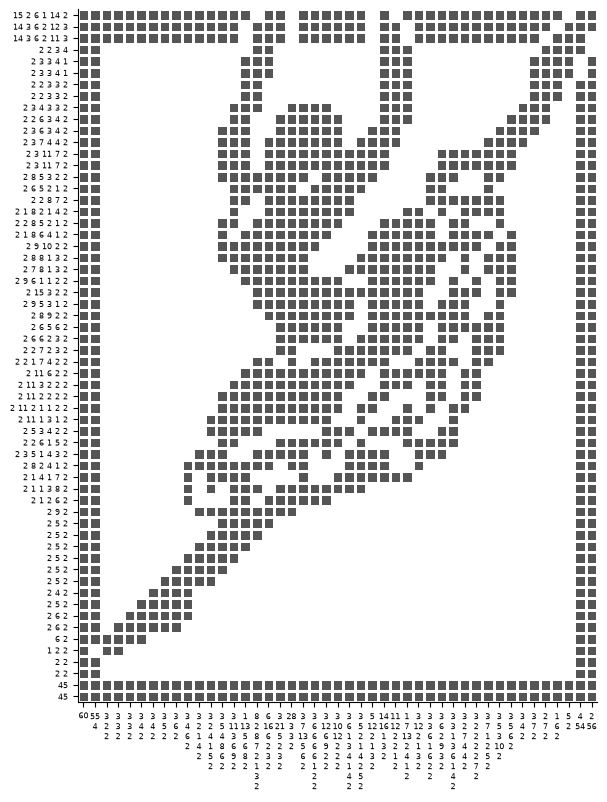
最后再解一道 45×60 的大型题目。
%time solve_and_paint("data/nonogram03.json", solver=NonogramFastSolver, font_size=6)
CPU times: total: 1.7 s
Wall time: 1.77 s
验算#
确认解出的盘面是否真的与提示一致,做法是数出连续黑格的长度,再与行、列的提示比较。这一步只检查答案,与求解无关,因此可以用最简单的写法。
def runs(line):
    """从一行中依次取出连续 1 的长度"""
    result, n = [], 0
    for x in line:
        if x:
            n += 1
        elif n:
            result.append(n)
            n = 0
    if n:
        result.append(n)
    return result


def check_nonogram(rows, cols, solution):
    ok_rows = [runs(solution[i]) for i in range(len(rows))] == [list(r) for r in rows]
    ok_cols = [runs(solution[:, j]) for j in range(len(cols))] == [list(c) for c in cols]
    return ok_rows and ok_cols


print("小谜题:", check_nonogram(rows, cols, pbn.solution))

with open("data/nonogram02.json") as f:
    data02 = json.load(f)
pbn02 = NonogramFastSolver(data02["rows"], data02["cols"])
pbn02.solve()
print("nonogram02 :", check_nonogram(data02["rows"], data02["cols"], pbn02.solution))
小谜题: True
nonogram02 : True
小结#
一行的提示可以用
paint_numbers()展开成全部涂法原样写成 CNF,子句会按候选的个数增加而爆炸,宽度 30 时超过两万种
把每个数字的起始位置做成变量,候选就只剩可以放置的位置,式子因而小得多
恰好一个与不能同时为真,可以用
only_one_true()这样的小组件写出行与列通过共用的格变量连接起来
有了本章的提速,原本十几秒的题目降到 0.2 秒左右,45×60 的题目也能在数秒内解出